RC Gliders: Soaring, Exploiting Thermals, and Slope Flying
RC gliders guide: types, how to exploit thermals, slope flying, brands, ENAC regulations, center of gravity and flaps, F3J/F5J competitions.
There's a form of model making that makes no noise. No turbine whistle, no engine hum, just the rustle of air over the wings and the silence of the sky. It's radio-controlled soaring, the art of staying airborne without propulsion, exploiting the free energy that the atmosphere gives to those who know how to read it. Piloting an RC glider means learning to converse with the wind, to feel the thermal that lifts, to read the slope and the clouds. It is, for many, the purest and most contemplative form of aeromodelling.
Yet soaring is also refined technique, applied physics and — at high levels — fierce competition. Behind the apparent calm of a gliding glider there are optimized airfoils, millimeter-precise centers of gravity, flaps adjusted for each flight phase, and race strategies timed to the second. In this guide we will explore everything: glider types, the art of finding and exploiting thermals, slope flying, reference brands, ENAC regulations for high-altitude flight, optimization of center of gravity and flaps, F3J/F5J competitions, and the different methods of gaining altitude.
Types of RC Gliders
The world of RC soaring is varied, and the first thing to understand is which glider family is right for you. Each type has different geometries, dimensions, and flight philosophies.
Trainer / School Glider
The entry point. Typically electric gliders (with motor in the fuselage) with 1.5-2 m wingspan, pronounced dihedral wings, built from EPO or wood-fabric. Stable, slow, forgiving. The electric motor allows you to climb to altitude autonomously, search for thermals, and — if you don't find one — restart and climb again. Perfect for learning the basics of soaring without relying on a slope or winch. Indicative cost: 100-250 €.
F5J — Electric Competition Thermal Glider
The current queen class. Gliders with 3-4 m wingspan, composite construction (carbon-balsa or full composite), electric motor only for initial climb. In competition, the motor switches off after the climb and the flight time in the air, exploiting thermals, counts. Extremely efficient, thin airfoils, exceptional gliding performance. Cost: from 400 € for accessible models to over 1,500 € for top competition models.
DLG / HLG — Discus Launch / Hand Launch Glider
The great little athletes. Very light gliders with 1.5 m wingspan, hand-launched with a body rotation (discus launch) by gripping a pin on the wingtip. They fly in small spaces, are incredibly responsive, and allow dozens of launches per session. A technical and physical discipline combined. Cost: 200-700 €.
Scale Glider
Reproductions of real full-size gliders — ASW, Discus, Nimbus, DG. Often 3-5 m wingspan and beyond, meticulously detailed aesthetics, majestic and realistic flight. They can be electric, towed (pulled by a powered aircraft), or winch-launched. For those who love scenic flight and elegance. Cost varies widely, from 300 € to several thousand for large scale models.

Thermals: Finding and Exploiting Them
Thermals are the heart of flatland soaring. It's a bubble or column of warm air that, heated by the sun on the ground, rises upwards. A glider entering a thermal is lifted "for free": the art of the soaring pilot is to find it, center it, and exploit it to gain altitude.
How Thermals Form
The sun heats the ground unevenly. An expanse of asphalt, a dark plowed field, a quarry, or a roof heats up more than a forest or a green meadow. The air above hot surfaces warms up, becomes less dense, and — when it reaches a critical mass — detaches from the ground, rising like a bubble. The best conditions are sunny days with some cumulus clouds: cumulus clouds are often the visible top of a thermal, where moisture condenses.
Reading the Signs
The experienced soaring pilot reads the thermal even before entering it. Precious clues are: birds (raptors, swifts) circling upwards without flapping their wings, blades of grass or leaves lifted from the ground, variations in the model's behavior — a wing suddenly lifting, the nose tending to rise. Modern transmitters with telemetry and variometer (an altitude change sensor that emits an increasing beep when climbing) are invaluable tools for "feeling" the thermal even at great distances.
Centering the Thermal
Once the lift is found, it must be centered. The classic technique is to turn tightly within the bubble: when you feel you are climbing, tighten the turn and look for the strongest lift point. If you climb more in one sector of the turn, shift the circle in that direction. It's a game of sensitivity and continuous corrections: the thermal moves with the wind, so the circle must be constantly "drifted" downwind to stay within the ascending core.
Tip: A variometer with audio telemetry literally changes the thermal search experience. Hearing the tone rise as the glider gains altitude allows you to center even weak bubbles that you would never recognize with the naked eye. For F5J flight, it is almost indispensable.
Slope Flying (Slope Soaring)
If thermals are for flatland flying, slope flying is for mountains and hills. The principle is different and fascinating: when the wind encounters a slope or a hill, it is forced to rise along its profile, creating a dynamic lift band in front of and above the relief. A glider positioned in this band is supported by the ascending wind, potentially for hours, without any motor.
Slope flying requires neither thermals nor a motor: just a constant wind (typically 15-40 km/h) blowing perpendicular to a suitable slope. This makes it possible even in winter or on cloudy days, when thermals are absent. It's dynamic, fast, and incredibly fun flying: on the slope, you can perform aerobatics, make low passes, and with strong winds, reach impressive speeds.
Slope Gliders
For slope flying, robust models are used, often made of EPP (impact-resistant foam) for "combat" and sport models, or high-performance composites for fast slope flying. The structure must withstand landings on rough terrain and turbulence. Thicker airfoils and strong wings are the norm.
Safety in Slope Flying
Slope flying is often practiced in mountainous areas: pay attention to turbulence downwind (the "rotor" behind the ridge that can flip the model), the presence of hikers, and choosing a slope with clean frontal wind. The golden rule is never to fly behind the ridge, where the air descends and is turbulent.

Main Brands
Soaring has a very strong European tradition, with German and Italian brands making history, alongside Eastern European specialists for competition composites.
Multiplex (Germany)
A benchmark for high-quality Elapor foam gliders. The Multiplex EasyGlider is one of the best school gliders ever, robust and forgiving; the range includes popular sport and slope models. Excellent for beginners and intermediates. Affordable prices, 100-300 €.
Robbe (Germany)
Historic German brand, rich in well-made scale and thermal gliders. Tradition and a wide range, from trainers to performance models. Good availability of kits and accessories.
Samba Model (Ukraine)
Specialist in competition composites. Models like the Pikes (Pike Perfection, Pike Precision) are legends in the F3J/F5J classes, built from top-level carbon-spread tow. Top performance, competition prices (over 1,000 €). For serious soaring pilots and competitors.
Tangent (Germany)
Manufacturer of refined competition gliders, highly regarded in the European F3J/F5J scene. Their models (e.g., the Explorer series) are benchmarks for precision and thermal performance. Premium segment.
Tip: For your first glider, a Multiplex EasyGlider or an equivalent electric trainer is the perfect choice: you learn thermals and piloting without spending a fortune and without the risk of destroying an expensive competition composite with your first mistake.
Optimization: Center of Gravity and Flaps
A poorly adjusted glider flies badly, period. Two adjustments make the difference between a model that floats in thermals and one that falls like a stone: the center of gravity and the flaps.
The Center of Gravity (CG)
The center of gravity is the longitudinal balance point of the model, and it is the most critical adjustment in soaring. A CG too far forward makes the glider stable but "heavy," gliding poorly and not climbing well in thermals. A CG too far back makes it responsive but unstable, to the point of becoming uncontrollable. The correct position is found by starting from the manufacturer's indicated value and then refining it with the dive test: the glider is brought to altitude, put into a 45° dive, and released. If it pulls up sharply on its own, the CG is too far forward; if it continues to dive, it's too far back; if it pulls up gently, it's correct. The lead or battery is moved a few millimeters at a time.
Flaps and Flight Phases
Performance gliders have multi-surface wings (ailerons + flaps) managed by the transmitter in programmable flight phases, each with a different airfoil geometry:
- Speed / Fast: flaps slightly raised (reflex), thin airfoil, minimal drag. For fast transit between thermals or rapid descent.
- Thermal / Float: flaps slightly lowered, more lifting airfoil. For floating and climbing in weak lift.
- Landing / Landing: flaps very lowered (crow/butterfly: flaps down and ailerons up) to create drag and brake for precision landing.
Mastering flight phases with a single switch or stick is what separates the experienced soaring pilot: changing wing configuration in real-time to adapt to every situation is the essence of modern soaring.

Climb Methods: Electric, Tow, Winch, Hand Launch
Without an engine, how do you get a glider to altitude? There are several methods, each with its own philosophy.
- Electric (F5J and trainer): The most practical and widespread. An electric motor in the fuselage takes it to altitude autonomously; then it switches off and you soar. Allows you to fly anywhere and climb again if you "miss" the thermal.
- Hand Launch (DLG/HLG): The glider is launched with an explosive body rotation, reaching 40-60 m altitude. No motor, no equipment: just the athlete and the glider.
- Winch / Bungee: Classic techniques where the glider is launched to altitude by a stretched elastic or a motorized winch. Typical of F3J competitions and traditional pure soaring.
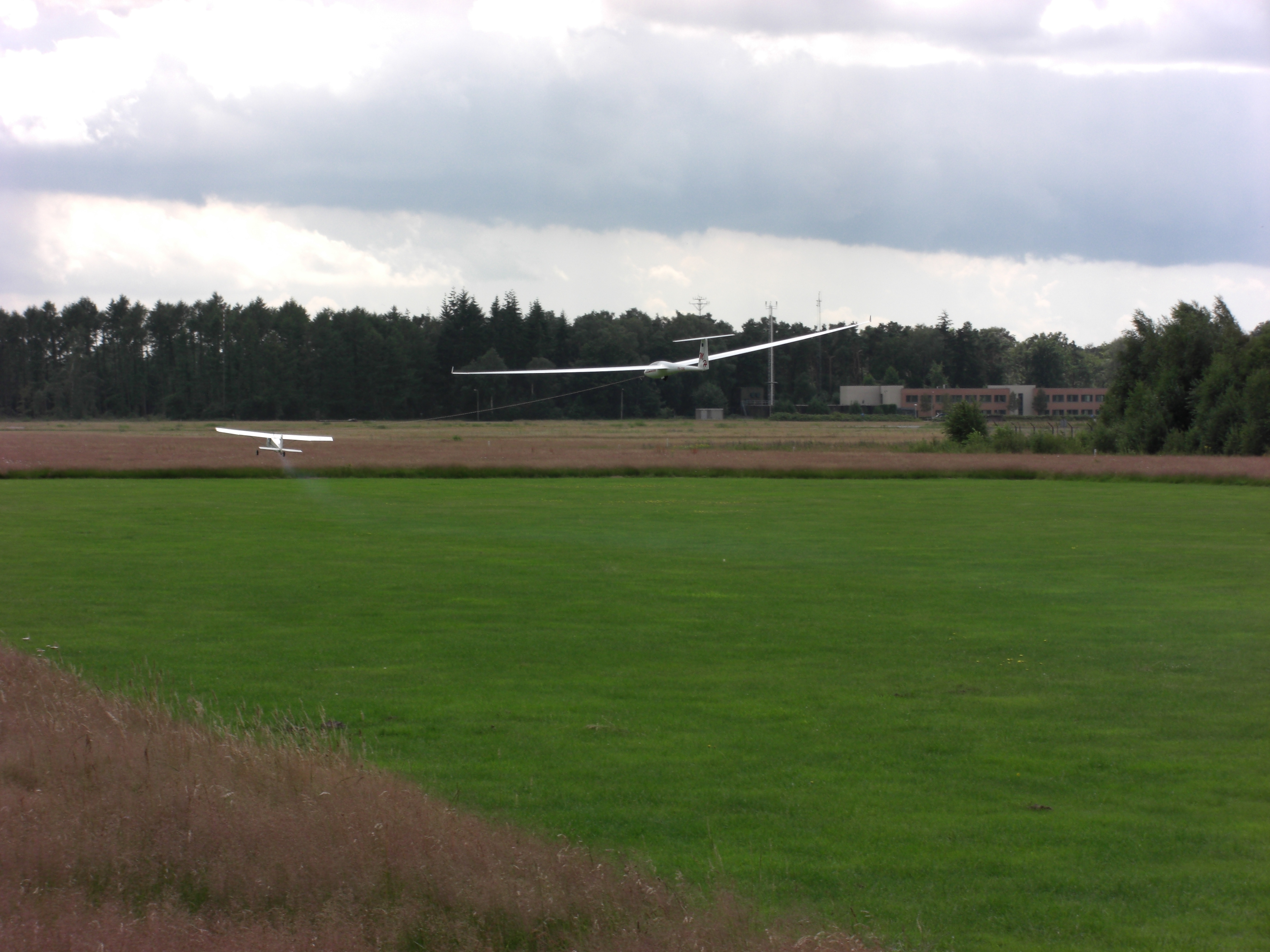
- Aerotow: Used for large scale models. A powered aircraft tows the glider to altitude with a cable, then releases it. Spectacular and very realistic for reproductions.
Competitions: F3J and F5J
Competition is the proving ground for soaring. Two classes dominate the international scene.
F5J — Thermal with Electric Motor
The most popular class today. The glider climbs with an electric motor for a limited time, then the motor switches off (recorded by an official altimeter/logger) and the flight time in thermals counts, with a precision landing on a target. The lower the motor cut-off altitude, the more bonus points: it rewards those who find the thermal quickly rather than climbing high with the motor. Strategy, air reading, and landing precision.
F3J — Thermal with Winch/Bungee
The historic class of pure soaring. Winch launches, timed flights (typically 10 minutes to be centered to the second), and precision landing. A very tough team discipline, where thermal reading and time management are everything. It's the "marathon" of soaring.
Tip: Even if you don't aspire to compete, attending an F5J event as a spectator is the best school there is. Watching top pilots center invisible thermals and land to the centimeter teaches more than a thousand manuals.
Equipment: Radio, Servos, and Telemetry
The modern glider, especially for performance, requires adequate electronics. It doesn't need power, but precision, lightness, and advanced programming functions.
The Radio
For performance soaring, a transmitter with a good number of channels (at least 6-8) is needed, and — above all — the ability to program flight phases with independent flap and aileron curves, as well as compensations (snapflap, aileron differential, butterfly mix for landing). Mid-to-high-end radios like Jeti, Multiplex, Futaba, or FrSky offer everything necessary. For DLG, ergonomics are very important, as you often fly "on the sticks" with fine adjustments during flight.
The Servos
In gliders, servos must be light and thin to fit into the very thin wings of competition models, but at the same time precise and with good center holding. High-resolution micro and mini digital servos are used: precision matters because a small misalignment of the flaps between the two wing halves compromises flight. In composite models, servos must be carefully embedded in the wing, and mechanical play in the linkages must be eliminated.
Variometer and Telemetry
As mentioned, the variometer with audio telemetry is the tool that revolutionizes thermal searching: a barometric sensor in the model transmits altitude changes to the radio, which emits increasing tones on ascent and decreasing tones on descent. It allows you to "feel" the air from a distance and center even weak lift. For F5J, an approved altimeter/logger is also necessary to record the motor cut-off altitude for scoring purposes.
Tip: Do not underestimate the quality of micro servos in the wing. A cheap servo with play in the center will make the flaps "wobble" and ruin the glide of an otherwise excellent glider. It's one of the few areas where it's not worth saving money.

ENAC Regulations for High-Altitude Flight
RC soaring, though silent and "green," is subject to aviation regulations like any other aeromodel. Key points to know:
- VLOS (Visual Line of Sight). The glider must always remain in direct sight of the pilot. This is a delicate point for soaring, because gliders can climb very high and move far away: the pilot must manage altitude and distance to never lose visual contact.
- Altitude Limits. EASA/ENAC regulations set altitude limits (typically 120 m from the takeoff point in the Open category, unless otherwise specified). Thermal gliders easily reach these altitudes: it is the pilot's responsibility to respect the limits of the airspace in which they operate.
- D-Flight Registration. The operator must register on d-flight.it according to the weight thresholds and apply the identification code.
- RC Insurance. Mandatory, generally included in membership with aeromodelling associations.
- Airspaces and Restricted Zones. Always check the D-Flight map for restricted zones (near airports, reserved areas). Mountain slope flying requires particular attention to airspaces.
Regulations are constantly evolving: always consult the updated version on ENAC and D-Flight before the season. Associations are a valuable support for guidance.
Conclusion
Radio-controlled soaring is a discipline that rewards patience, sensitivity, and knowledge of the air. There is no brute jet power or 3D adrenaline, but there is something more subtle: the pleasure of staying in the sky thanks only to the atmosphere's energy, of reading a thermal like reading a book, of feeling the wind on the slope supporting your glider for hours.
Start with an electric trainer to learn thermals and piloting, experiment with slope flying when you find the right wind, refine your center of gravity and flaps, and — if you get hooked — dive into F5J competitions. The silent sky of gliders awaits you. Happy thermals and clear skies.