RC Cars for Beginners: How to Choose Between Buggy, Drift, Crawler, and Touring Car
The ultimate guide for RC car beginners: categories, scales, RTR vs. kit, batteries, brands, and realistic budgets to get started on the right foot.
Radio-controlled cars are one of the most vibrant and accessible segments of dynamic model making. Unlike airplanes or helicopters, an RC car is very forgiving: if you make a mistake, it doesn't fall from the sky; it simply slows down, turns, or at most, flips over. This makes them the ideal entry point for anyone wanting to get into RC modeling without the risk (and cost) of destroying everything at the first mistake.
However, the enormous variety of available models presents the first difficulty for the novice. Buggy, truggy, monster truck, short course, touring car, drift, crawler: each category has a driving philosophy, an ideal terrain, and a target audience. Choosing the wrong first car means getting frustrated or bored quickly. This guide aims to walk you through the conscious choice of your first RC car, step by step.

Main Categories: Find Your Way
Before talking about scales, batteries, and brands, you need to understand what type of driving appeals to you. Each category meets a different need.
Off-road Buggy (2WD and 4WD)
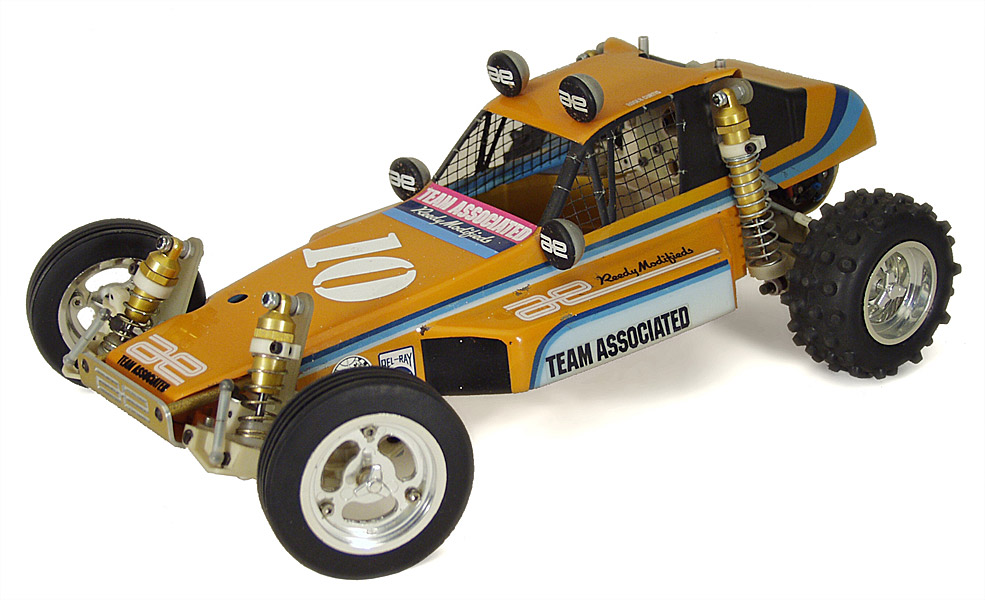
The buggy is the quintessential dirt car: light, nimble, with long-travel suspension and knobby tires. It's driven on dirt tracks, lawns, and unpaved parks. The 2WD (rear-wheel drive) is cheaper, more challenging to drive but extremely educational; the 4WD (all-wheel drive) offers more grip and speed, being more forgiving of errors. It's the most complete category for truly learning to drive.
On-road Touring Car
The touring car is the asphalt track car: low chassis, slick or asphalt-tread tires, stiff setup. It's driven on indoor carpet tracks or outdoor asphalt circuits. It's the category of trajectory precision and timed competition. Very fast and technical, less suitable for those just looking for occasional fun in the garden.
Drift
RC drift replicates the controlled skids of real drift cars. It uses hard plastic tires that intentionally reduce grip, on smooth surfaces (tiles, asphalt, dedicated carpet). Speed doesn't matter, but style does: angle, control, fluidity. It's spectacular and has a very strong community linked to JDM culture.
Crawler and Trail
The crawler is the opposite of speed: a very slow car designed to climb rocks, roots, and extreme obstacles. Large articulated suspensions, locked differentials, soft sticky tires. It's the category of pure technique, scale realism, and exploration on trails. Perfect for those who love calm and precision.
Short Course Truck
The short course is an off-road truck with a wide body that replicates American racing pickups. Robust, fun, tolerant of impacts thanks to the wraparound bodies. An excellent compromise for those who want a solid car for bashing (free driving without rules) in the garden and park.
Tip: If you have no idea what you like, start with a 4WD buggy or a 1:10 scale short course. They are versatile, robust, and allow you to understand what you really enjoy before specializing.
Scales: 1:8, 1:10, and 1:18 Compared
The scale indicates the reduction ratio compared to a real car and determines the model's size, weight, cost, and performance.
- 1:18 Scale (and mini 1:24/1:28): small, economical, ideal for playing indoors or in small spaces. Great as a first approach or for indoor crawlers. Less specialized spare parts.
- 1:10 Scale: the absolute standard of the industry. The best balance between manageable size, performance, spare parts availability, and price. There are buggies, touring cars, drift cars, crawlers, and short courses in 1:10. If you're undecided, this is where you should look.
- 1:8 Scale: large, powerful, high-performance. Typical of competition buggies and truggies (often nitro or high-power brushless electric) and high-end scale crawlers. Higher costs and speeds, requires ample space.
For a beginner, the 1:10 scale is almost always the most sensible choice: you'll find models for every budget and widespread spare parts in every model shop.

RTR, Kit, or Custom: How to Buy an RC Car
Once you've chosen the category and scale, you need to decide the starting assembly level.
RTR (Ready To Run)
The model arrives fully assembled and ready to use: chassis, motor, ESC, receiver, radio, and often even battery and charger are included. You just need to charge the batteries and turn it on. It's the recommended choice for 90% of beginners: zero technical skills required, immediate fun.
Kit (Self-assembly)
You receive a box of components to assemble by following the manual. You need to purchase the motor, ESC, servo, radio, and battery separately. It requires time, tools, and patience, but it teaches you to know every part of the car — invaluable for those who want to race and fine-tune the setup. Typical of touring cars and competition buggies.
Custom / Scratch
Complete construction from scratch or heavily modified, typical of the scale crawler world and custom drift. Maximum personalization, reserved for those with experience.
Tip: Your first model should be RTR. You'll learn to drive immediately and understand what you like. The kit will come later, when you want to optimize the setup for races.
Batteries: LiPo vs. NiMH
The power supply for modern electric RC cars is a choice between two technologies.
- NiMH (Nickel-Metal Hydride): economical, robust, safe, and tolerant. They are often included in entry-level RTR packages. Heavier and with lower energy density, but perfect for starting without worries.
- LiPo (Lithium-Polymer): lighter, with higher energy density and the ability to deliver high currents (more power and speed). However, they require careful management: chargers with balancers, never discharge them below 3.5V per cell, storage at storage voltage (3.8V/cell), and storage in fireproof bags.
LiPos are classified by cells: a 2S (7.4V nominal) is the standard for most 1:10 cars, a 3S (11.1V) powers more high-performance models. Start with NiMH or a 2S and a good charger with a balancer.
Main Brands
Knowing the brands helps you navigate quality, support, and spare parts availability.
- Traxxas (USA): the king of robust and powerful ready-to-run. Models like Rustler, Slash, and Stampede are legendary for reliability and support. Excellent for bashing.
- Arrma (USA): specialist in extreme bashing and high-speed brushless models (Typhon, Granite, Kraton). Very robust, fun, powerful right out of the box.
- Team Associated (USA): historic competition brand. The B-series buggies (B6, B74) and short courses are benchmarks in racing.
- Kyosho (Japan): excellent build quality, from Inferno buggies to scale offerings. History and prestige.
- Tamiya (Japan): the brand of kit love. Chassis like the TT-02 are perfect training grounds for learning to assemble and drive, with a universe of iconic bodies.
- HPI Racing (Japan): pioneer of drift and on-road, with versatile chassis and spectacular bodies.

Realistic Budget: How Much to Spend to Start
RC cars cover a huge price range. Here are realistic ranges to get started.
- Entry (€100-150): Complete RTRs with radio and often NiMH battery. Brushed motor, great for understanding if you like the hobby. Examples: small buggies and short courses from brands like WLToys or entry-level Tamiya/HPI.
- Sport (€200-400): Higher quality RTRs, often brushless, with better electronics and more robust chassis. This includes entry-mid Traxxas and Arrma. This is the range with the best fun/price ratio.
- Performance (€500+): Competition kits (Team Associated, Kyosho, Xray) or high-performance 1:8 brushless. At this budget, you'll need to add quality electronics, LiPos, and accessories. This is the territory for those who race or seek the best.
Tip: Don't forget accessories. A good radio, additional batteries, a charger with a balancer, and some common breakage spare parts (suspension arms, reducers) are inevitable expenses. Consider an additional 20-30% on the model's price.
The Radio: Included in RTR or Aftermarket?
RTR models include an entry-level 2 or 3-channel radio, perfectly functional for starting. When you want more precision and functions (model memories, fine steering/brake/throttle adjustment, telemetry), you can switch to an aftermarket radio from brands like Sanwa, Futaba, Spektrum, or FlySky. For the first model, the included radio is perfectly fine: invest in a dedicated radio only when you feel the need for advanced features.
Indoor vs. Outdoor: Where to Play
The choice of terrain influences the type of car and tires.
- Indoor: carpet tracks for touring cars, drift on tiles/parquet, crawlers on obstacle courses. Clean, controlled, perfect for winter.
- Outdoor: buggies and short courses on dirt, grass, and parks; touring on asphalt; crawlers on rocks and real trails. More freedom but more wear and dirt.
Brushed vs. Brushless: Understanding the Motor
A chapter every beginner encounters is the difference between the two types of electric motors.
- Brushed: simple and economical technology, found in entry-level models. Carbon brushes wear out with use and the motor heats up more, but it's robust, tolerant, and perfect for learning without spending a lot. No programming required.
- Brushless: more efficient, more powerful, more durable, and without wear parts. It delivers much more power for the same consumption and, combined with a programmable ESC, allows fine-tuning of power delivery and braking. It's the standard for everything sport and performance, but it costs more.
For the first model, a brushed motor is perfectly fine; the jump to brushless comes naturally when you want more speed and durability. Many sport-range RTRs are already brushless as standard.
Essential Accessories
Buying the car is just the beginning. To enjoy the hobby without frustration, some fundamental accessories are needed from day one.
- Charger with balancer: essential if you use LiPo. Charges safely and balances the cells. Avoid "wall" chargers without balancing.
- Additional batteries: only one battery means 15-20 minutes of play and then hours of waiting. Having 2-3 packs multiplies the fun.
- Set of RC wrenches and screwdrivers: metric hex keys, wheel nut wrenches, turnbuckle wrenches. The tools included in the kit are often poor quality.
- Common breakage spare parts: suspension arms, steering links, ball joints. They always break, better to have them ready.
- Spare or additional tires for the terrain you frequent.
Tip: Budget about 25-30% of the model's price for first-day accessories. It's an expense that prevents the frustration of a stalled car or a day ruined by a trivial breakage.
Basic Maintenance Every Beginner Should Know
RC cars need simple but regular care. Learning basic maintenance greatly extends the model's life and teaches you to know it.
- Cleaning after use: remove dirt, grass, sand, and dust with brushes and compressed air. Dirt is the number one enemy of bearings and electronics.
- Screw check: vibrations loosen fasteners. A periodic check of tightness prevents lost parts on the track.
- Bearings: should be kept clean and, if necessary, lubricated or replaced when they feel stiff or noisy.
- Transmission gears: check for tooth wear and proper meshing (the "play" between pinion and spur gear).
- Electronics: keep the receiver and ESC dry. Water and non-waterproof models don't mix.
How to Drive an RC Car: The Fundamentals
Even though RC cars are very forgiving, some driving fundamentals make the difference between having fun and getting frustrated from the first few minutes.
- Mentally reverse the steering when the car comes towards you: when the model moves towards you, the steering commands appear "inverted" from your perspective. This is the number one hurdle for beginners. Practicing figure eights helps develop this automatic response.
- Gradually apply throttle: flooring the throttle from a standstill only makes the wheels spin or the car wheelie. Traction is built by modulating the accelerator.
- Brake before turning, not in the turn: like in a real car, you slow down on the straight and enter the turn at the right speed.
- Look where you want to go: anticipate the trajectory instead of chasing the car with your eyes. Smooth driving comes from anticipation.
To practice without risk, set up a course with cones in a parking lot and repeat slaloms, figure eights, and braking. In a few sessions, coordination significantly improves, and the "inversion problem" becomes automatic.
Ready-to-Run RTRs: What to Check Before Buying
When choosing an RTR, some details make the difference between a successful purchase and a disappointing one.
- Motor type: brushed (entry) or brushless (sport). Check what's included and if it's suitable for your level.
- Included battery and charger: some inexpensive RTRs don't include them. Consider the additional expense.
- Water resistance: many bashing models are waterproof (you can drive on wet terrain), others are not.
- Spare parts availability in Italy: crucial. A brand with widespread spare parts (Traxxas, Tamiya, Arrma) saves you long waits when you break a part.
- Battery connector: check the type (Deans, EC3, XT60) for compatibility with chargers and additional batteries.
Common Beginner Mistakes (and How to Avoid Them)
Learning from others' mistakes saves time and money. Here are the most frequent traps.
- Over-discharging LiPos: going below 3.5V per cell irreparably damages the battery. Use the ESC's cut-off or a timer.
- Starting with an overly powerful model: an 80 km/h 1:8 brushless as a first car is unmanageable and quickly destroyed. It's better to grow gradually.
- Ignoring tires: using the wrong tires for the terrain frustrates even the best driver. Always match tires to the surface.
- Neglecting cleaning: wear accelerates enormously if sand gets into the bearings.
- Not reading the manual: it contains valuable information on maintenance, spare parts, and adjustments.
The Italian Community and Where to Play
RC modeling in Italy is vibrant and welcoming. There are organized tracks for off-road and on-road in many regions, managed by clubs affiliated with federations like AMSCI (Associazione Modellismo Sportivo Italiana). Clubs organize races, training sessions, and gatherings where experienced drivers gladly welcome newcomers, and often provide well-maintained tracks with optimal grip that is impossible to replicate in a garden.
For free bashing, a park, a square, or a garden is enough — always respecting others and public spaces. For crawling, mountain trails and riverbeds offer spectacular natural terrains. Online, Facebook groups and dedicated forums are treasure troves of advice, setups, and used opportunities. Used models, on specialized marketplaces like VendoModellismo, are an excellent source for finding a first model at a reduced price or for recovering spare parts at low costs. Buying a good used higher-end model is often more convenient than buying a new entry-level one that will quickly feel too small.

Conclusion
Getting into RC cars is simple: the key is to choose the category you enjoy, start with a 1:10 scale RTR from a reliable brand, and don't rush to the top. Learn to drive, get to know the community, get your hands dirty with basic maintenance, and equip yourself with the right accessories from the start. Whether you dream of drift skids, crawler climbs, buggy jumps, or the millimeter-precise trajectories of a touring car, there's a perfect RC car waiting for you. The final advice is always the same: have fun without rushing, gain experience, and let passion guide your next purchases. Have fun and full throttle (with judgment)!