RC Crawler: Trail, Scale, and Extreme Climbing — Complete Guide
Complete guide to RC crawlers: scales, brands, kit vs. performer, tires, differential locking, portals, setup, obstacle courses, scale realism, and the Italian trail community.
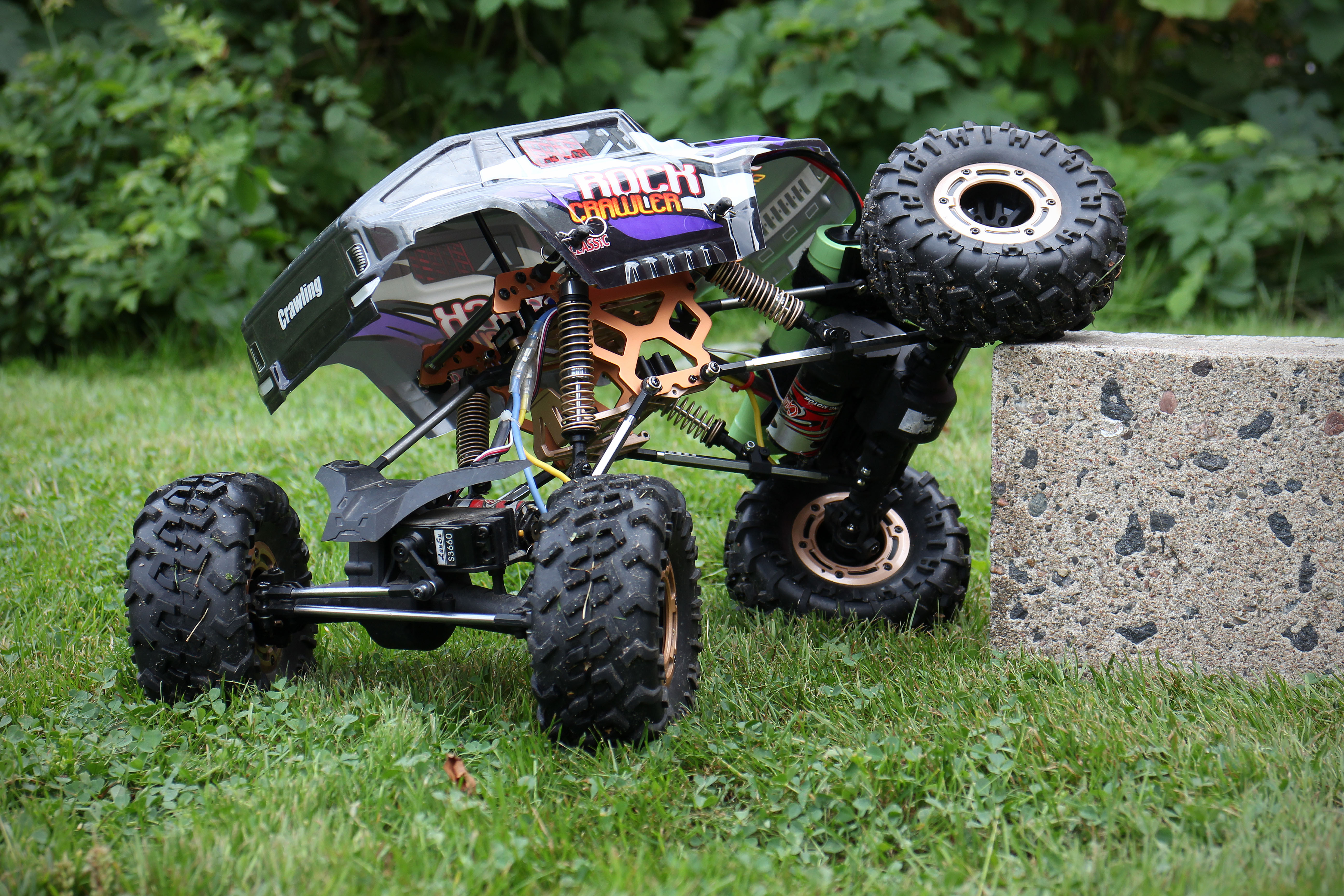
In a world of RC cars that seek speed and adrenaline, the crawler represents the opposite philosophy: slowness, precision, realism. An RC crawler doesn't race — it climbs. It tackles rocks, roots, logs, and slopes with the patience and technique of a real miniature off-road vehicle, replicating the feats of extreme 4x4 off-roaders. It's a discipline that rewards concentration, terrain reading, and a love for scale detail.
From relaxing trail drives along natural paths to climbing competitions on highly technical courses, crawling has won over a passionate and loyal community. In this complete guide, we explore everything: what a crawler is, scales, brands, the differences between kit and performer, tires, differentials, portals, setup, and the fascinating world of scale realism.

What is an RC crawler
A crawler (from the English "to crawl") is a 4x4 radio-controlled car designed to overcome extreme obstacles at very low speeds. Its distinctive features are: long-travel and highly articulated suspensions (to keep all wheels on the ground on uneven terrain), locked differentials (for maximum traction), soft and sticky tires, a low center of gravity, and a very short gear ratio that provides torque rather than speed.
There are two main souls in crawling: trail, which prioritizes realism and relaxed driving on natural paths, and competition crawling, focused on pure performance to overcome artificial obstacle courses in the fewest attempts.
Scale 1:10 vs 1:8
The most common scale is 1:10, the industry standard with the widest range of models, bodies, and spare parts. Compact enough to transport easily, large enough to tackle real obstacles. 1:8 and larger scales offer even more scenic presence, greater ability to overcome large obstacles, and impressive realism, at the cost of larger dimensions, weight, and budget. To start, 1:10 is the universal choice.
Key brands
The crawler world has specialized brands much loved by the community.
- Axial SCX10 III: the absolute benchmark for 1:10 scale trail. Balanced, realistic, with an infinite universe of spare parts and accessories. The most recommended choice for a serious start.
- Traxxas TRX-4: rich in features (two-speed transmission, radio-lockable differentials, rear steering in some versions). Robust and technological RTR, excellent for those who want everything ready.
- RC4WD: the brand of extreme realism, with scale ladder frames, real off-road details, and premium build quality. Loved by scale builders.
- Redcat Racing: excellent value for money, accessible models to enter the crawler world without great expense.
- Cross RC: specialist in multi-axle scale trucks (4x4, 6x6) and highly detailed construction kits.
- Gmade: frames and kits appreciated for quality and originality of proposals.
Scale kit vs performer
In crawling, two approaches coexist. The scale kit (scale rig) aims for maximum realism: detailed body, ladder frame like real off-road vehicles, scale accessories, relaxed driving on the trail. The performer (competition rig) is optimized for pure performance: very low center of gravity, extreme geometries, optimized weight, often with essential aesthetics. Many start with scale for the pleasure of realism and then, if they get passionate about racing, build a dedicated performer.

The tires: contact with the rock
In crawling, tires are the most important component of all. They determine how well the car grips surfaces.
- Soft compound: the softest and stickiest compound possible is sought for maximum grip on rock and wood. Soft tires deform and "stick" to obstacles.
- Aggressive tread: large, deep, and spaced lugs that bite into the terrain and provide grip on the edges of obstacles.
- Foam inserts: the internal foam insert determines how much the tire deforms. Soft inserts allow the tire to wrap around obstacles for maximum traction.
Brands like Pro-Line, RC4WD, and JConcepts offer specific crawler tires for every type of terrain and size.
Differential locking
While in buggies differentials are adjusted with oil, in crawling, the goal is almost always total locking (locked diff or spool). A locked differential forces both wheels on the axle to spin at the same speed: this ensures maximum traction, because even if one wheel is lifted, the other continues to receive torque. On a crawler with all differentials locked, every wheel in contact with the ground always pushes. Some models (like the TRX-4) offer electronically lockable differentials from the radio, to choose on the fly between agility and maximum traction.
Portals (portal axles): more height, more torque
Portal axles are a refined technical solution borrowed from real military off-road vehicles. They move the wheel hub lower than the axle shaft via a pair of gears: this increases ground clearance under the differentials and provides additional final reduction (more torque, less speed). For a crawler, this means being able to overcome higher obstacles without getting stuck with the differential and having even more climbing power. They are present on many mid-to-high-end scale models.
Batteries for crawlers
Crawlers do not require explosive power but constant and smooth delivery. 2S LiPo (7.4V) are the ideal standard: they provide the necessary torque with manageable delivery and low weight. Some purists prefer low battery placement to lower the center of gravity, a crucial aspect for not rolling over on side slopes. There are also cylindrical cell solutions for scale realism.
An advantage of crawling is the exceptional autonomy: since it is driven slowly and with low absorption, a single battery can last hours on the trail, much longer than in any other RC discipline. This makes the crawler perfect for long excursions, where there is no need to carry a stack of spare batteries. The placement of the battery's weight is also one of the main tools for balancing the vehicle: moving it low and towards the opposite side of the motor helps counteract the tendency to roll over on lateral traverses, one of the most treacherous situations in crawling.
Setup: reach and steering angles
Crawler setup revolves around a few key parameters:
- Low center of gravity: the crawler's number one enemy is lateral rollover. The center of gravity is lowered as much as possible by positioning the battery and electronics low and outward (opposite side of the motor, to balance).
- Suspension articulation (flex): maximum travel is sought to keep all wheels on the ground. This is adjusted with spring and shock absorber stiffness.
- Steering angle: a good angle allows maneuvering in tight spaces between obstacles.
- Gearing: short to have torque and control at very low speeds.
Tip: on a crawler, weight matters a lot and must be positioned well. A few grams moved low and outward can transform a car that rolls over into one that stays glued to the ground on the most challenging traverses.
Obstacle courses: gates and boulder gardens
Crawler competitions take place on technical courses. Gates are delimited by poles that the car must pass through in the correct order without touching them (each touch is a penalty). Boulder gardens are piles of natural or artificial rocks to be overcome with technique alone. Competition crawling races reward those who complete the course with the fewest penalties and attempts, while scale trail events (like scale challenges) also evaluate realism, onboard equipment, and the vehicle's fidelity.
Scale realism: lights, sounds, and details
One of the most loved aspects of crawling is scale realism: transforming the model into a faithful reproduction of a real off-road vehicle. Typical modifications include:
- Functional LED lights: headlights, fog lights, roof LED bars, taillights.
- Engine sound simulators that reproduce the engine's roar based on throttle.
- Scale accessories: functional winch, jerry cans, tools, spare wheel, roof luggage, driver figures.
- Body details: weathering, realistic mud, stickers, and license plates.
Most loved scale bodies
The choice of body defines the crawler's personality. The most iconic ones reproduce legendary off-road vehicles: the Land Rover Defender (the ultimate trail icon), the Mercedes G-Class (boxy and robust), Toyotas (Land Cruiser, Hilux, FJ — much loved by overlanding culture), but also Jeep, Ford Bronco, and Chevrolet. The body is chosen for both aesthetics and dimensions (it must fit the chassis wheelbase).
Motor, ESC, and gearing: gentle power
The crawler has propulsion needs opposite to buggies and touring cars. Speed is not needed, controllable torque at very low RPMs is.
- Motor: brushed or brushless motors with high turns (low RPM, high torque) are used. Low KV motors deliver smooth and progressive force, ideal for millimeter control over obstacles.
- ESC: must have excellent delivery at minimum RPMs (crawling mode), with linear response and good "drag brake" (engine brake that holds the vehicle on an incline when you release the throttle).
- Gearing: very short, to multiply torque. Combined with any portal axles, it gives the crawler the strength to climb almost vertical walls at a walking pace.
The drag brake is particularly important: on a steep climb, when you release the throttle, the car must remain stationary instead of rolling backward. Good adjustment of this parameter makes the crawler as controllable as a real off-road vehicle.
Hard body vs lexan bodies
Crawler bodies are divided into two main families. Lexan (polycarbonate) are lightweight, impact-resistant, and flexible — practical for those who prioritize intense use. Hard bodies (made of rigid ABS plastic or resin, like the famous detailed ABS-style bodies) offer significantly superior realism, with faithful lines, transparent windows, interiors, and static model details, but are more fragile and heavier. Scale realism enthusiasts almost always choose hard bodies for aesthetic fidelity, accepting the compromise of greater care in use.

Trail and scale challenge: how to compete
Crawler competitions are divided into two major philosophies, both fascinating.
Competition crawling
Focused on pure performance: courses with numbered gates are tackled, to be crossed in the correct order without touching the poles. Every touch, every reversal of direction, and every rollover incurs penalties. The winner is the one who completes the course with the lowest penalty score. Line reading and absolute control of the vehicle are rewarded.
Scale challenge
Combines driving with realism. In addition to overcoming obstacles, the fidelity of the vehicle, onboard equipment (winch, tools, scale cargo), and often takes place on long natural trails with challenges such as crossing a stream, using the winch to recover the vehicle, overcoming logs. It is the discipline that best embodies the spirit of miniature overlanding.
Tip: in competition crawling, the golden rule is calm. Most penalties arise from haste. Study the line, advance very slowly, and use all suspension articulation to keep the wheels on the ground.
The winch and functional accessories
One of the most loved and useful accessories in scale crawling is the functional winch. Controlled by a radio channel, it allows the vehicle to be recovered from impossible situations — just like a real off-road vehicle stuck in mud — by hooking the cable to a fixed point and pulling. In addition to the winch, functional accessories include LED lights, sound simulators, and even smoke. These details are not just aesthetic: in scale challenges, the winch is often indispensable for overcoming the most difficult tests.
The Italian trail rider community
Crawling in Italy has a passionate and particularly welcoming community, thanks to the relaxed nature of the discipline. Trail riders meet for group outings along mountain trails, riverbeds, and natural paths, where driving becomes almost a miniature excursion. There are clubs and social groups that organize rallies, scale challenges, and competition crawling races, as well as building permanent obstacle courses for year-round training.
The atmosphere is collaborative: crawlers often stop, vehicles are photographed in natural settings, and advice on builds and setups is exchanged. It is perhaps the most "social" and contemplative discipline in the RC world, where the journey matters more than the destination and photographing your vehicle on a beautiful rock is part of the fun. For spare parts, scale accessories, and used models, specialized marketplaces like VendoModellismo are a valuable resource for the community, especially for those looking for specific parts for their custom builds.
Trail vs competition: two philosophies compared
It's worth delving into the two main souls of crawling, as they guide every purchase and setup choice.
Trail is contemplative driving along natural paths. Realism (detailed body, accessories, scale), relaxed driving, and the pleasure of taking your vehicle into spectacular scenarios are prioritized. There is no stopwatch or ranking: the journey is the destination. It's perfect for those looking for a relaxing hobby, who love photography and detail, and perhaps take the crawler on excursions with family or friends.
Competition crawling, on the other hand, is pure performance. On technical courses with numbered gates, the goal is to overcome obstacles with the fewest penalties. Competition vehicles sacrifice realism for efficiency: very low center of gravity, extreme geometries, optimized weight. It's the choice for those who love technical challenges, aggressive setups, and competition. Many enthusiasts practice both disciplines with different vehicles, enjoying the best of both worlds. The beauty of crawling lies precisely in this versatility: the same hobby can be meditative or competitive depending on how it is experienced.
Crawler suspension: solid axles and links
Unlike buggies with independent suspension, crawlers almost always use solid axles, like real off-road vehicles. The axles are connected to the chassis via links (reaction arms) according to 3 or 4-link schemes, which determine how the axle moves and articulates. Link geometry influences articulation (flex), rollover tendency, and climbing behavior. Adjusting the length and angle of the links is an important part of advanced setup: a good link scheme maximizes grip by keeping the wheels in contact with the ground even on the most uneven traverses. Shock absorbers, generally oil-filled, are set soft to favor maximum articulation.
How to start crawling
A recommended path for beginners:
- Choose a proven 1:10 scale RTR (Axial SCX10 III or Traxxas TRX-4): ready to use, robust, with extensive spare parts.
- Immediately invest in good soft tires: this modification changes performance the most.
- Lock the differentials and lower the center of gravity by moving the battery and electronics.
- Find a trail or a boulder garden and start training your terrain reading and throttle control.
- Customize with scale realism as your passion grows: lights, accessories, winch, detailed body.
Conclusion
The RC crawler is a discipline that teaches patience and rewards technique. Start with an Axial SCX10 III or a Traxxas TRX-4 in 1:10 scale, mount good soft tires, lock the differentials, lower the center of gravity, and set off to discover the first trail. Whether you're passionate about contemplative trail driving, the technical challenge of races, or the art of scale realism, crawling will give you hours of concentration, satisfaction, and scale beauty. Grab your crawler, find a nice rock, and start climbing. Happy trails!