
Cinematic and Freestyle FPV Drones: differences from racing, setup and aerial footage
Racing, freestyle and cinematic are not the same thing. Practical guide to cinewhoops, naked cams, choosing motors and propellers for smooth flights, sub-250g frames, ReelSteady/Gyroflow software stabilization and analog or digital FPV systems. With a mention of drone regulations in Italy.
When talking about FPV (First Person View) drones, the mind immediately turns to speed races: 5-inch quads whizzing through illuminated gates at over 150 km/h. But the world of first-person flight is much broader. Alongside pure racing, two disciplines have grown with completely different rules, hardware, and objectives: freestyle and cinematic. If you're approaching FPV today with the idea of recording spectacular aerial footage, this is where you need to look. This guide explains the differences and how to build a setup designed for fluidity, not for the stopwatch.

Racing, freestyle and cinematic: three different philosophies
Racing is optimized for one thing: going as fast as possible along a track. Everything is sacrificed for speed and acceleration; the aesthetics of the flight don't matter. Freestyle, on the other hand, aims for expression: power loops, split-S, dives over buildings and mountains. It requires a powerful quad but with a smoother and more predictable flight, because the footage must be enjoyable, not just fast.
Cinematic is the opposite pole of racing. Here the goal is image quality and movement fluidity: slow dollies, precise approaches, passages through tight spaces without jerks. Speed becomes almost a defect, because a movement that is too fast or nervous ruins the shot. From this comes a dedicated category of drones: cinewhoops.
Cinewhoops: protected propellers for close-up shots
The cinewhoop is a compact quad (typically 2.5 or 3 inches) with propellers enclosed in protective ducts. This feature changes everything: you can fly inches from people, furniture, walls, and objects without risking damaging them or injuring anyone if you hit something. It's the ideal drone for indoor shooting, passing through rooms, product showcases, events, and all those situations where an uncovered 5-inch quad would be dangerous.
The ducts, in addition to protecting, increase static thrust: the cinewhoop hovers stably and forgives many piloting errors. The disadvantage is weight and lower efficiency at high speeds, but for cinematic, it's not a problem. Even smaller variants exist, the tiny whoops under 30-40 grams, perfect for learning and for shooting in tiny environments.
Naked cams and action cams: recording in high quality
The FPV video system (what you see in the goggles) has a quality designed for minimum latency, not for storage: it's not enough for a finished video. For this reason, a camera that records in high resolution is mounted on board. There are two main options.
- Full action cam: a GoPro or a DJI Osmo Action mounted on the frame. Maximum quality and integrated stabilization, but it weighs a lot (over 100-150 g) and penalizes autonomy and agility.
- Naked cam: a GoPro "stripped" of its casing, battery, and screen, reduced to just the sensor-lens module powered by the quad. It weighs a fraction (around 30 g) while maintaining almost the same image quality. It's the typical choice for cinewhoops and sub-250g drones, where every gram counts.
The naked cam requires more care in assembly and thermal management, but allows for 4K footage on very light drones.
Motors, propellers and ESCs: choosing for fluidity
For racing, high KV motors and lots of instant torque are sought. For cinematic and freestyle, the criterion changes: control is needed, not brute power. A lower KV motor paired with a higher cell count battery provides a more linear and manageable response, ideal for smooth movements.
Propellers play a huge role. Tri-blade or quad-blade propellers with a low pitch offer smooth flight and fewer vibrations compared to aggressive racing bi-blades. On cinewhoops, the propellers inside the ducts are designed to push air consistently rather than for top speed.
The ESC (motor controller) must manage low speeds and continuous micro-corrections well: good firmware (e.g., BLHeli_32 or AM32) with an adequate PWM frequency avoids jerks in slow movements, where an ESC designed only for high throttle would produce visible jumps in video.
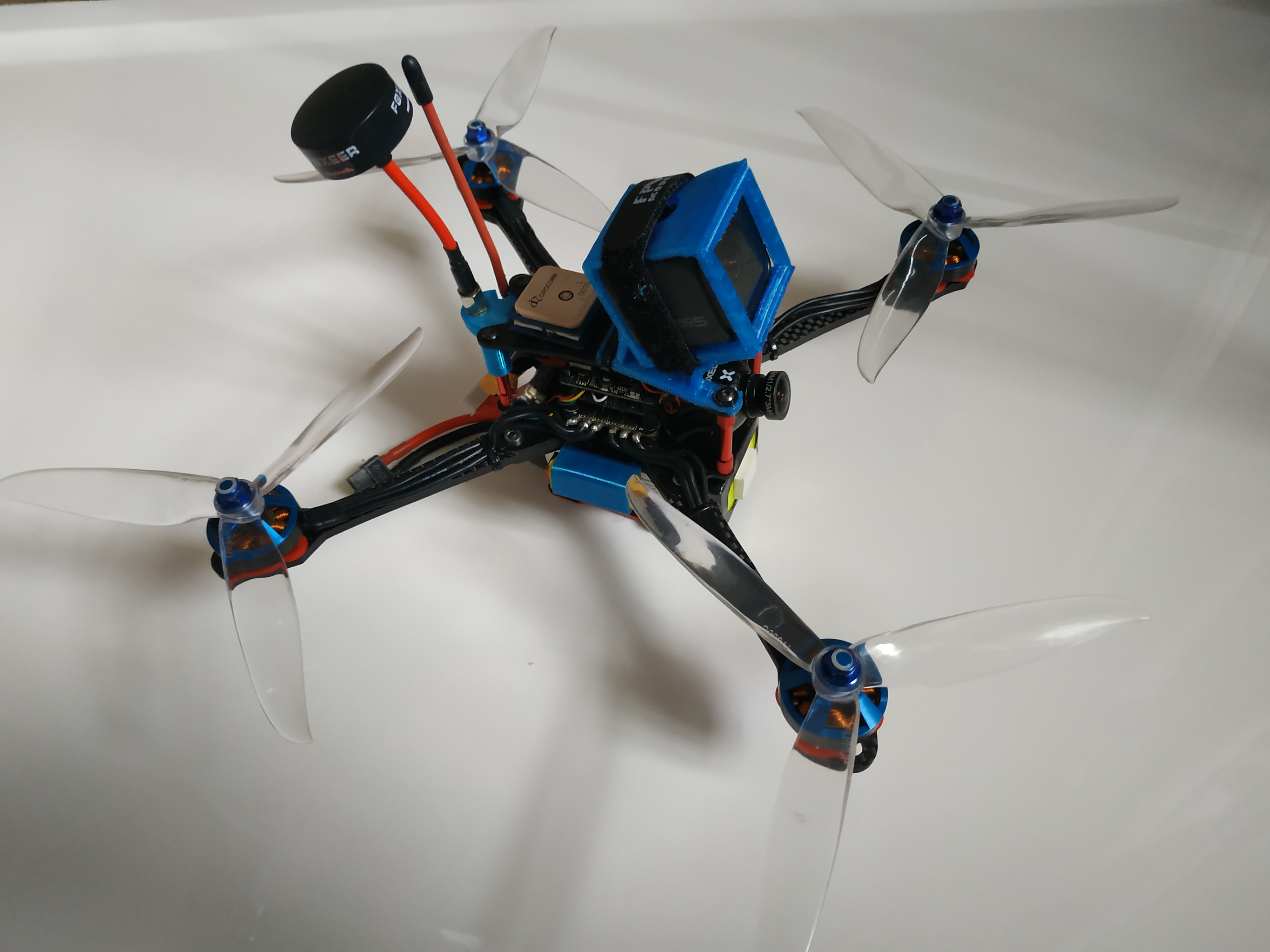
Frames: 3-5 inches and the sub-250 gram threshold
The frame size (expressed in inches, referring to the propeller diameter) defines the drone's character. 5 inches is the freestyle standard: powerful, capable of carrying a full GoPro and handling wind. 3 inches is the meeting point between agility and lightness, widely used for outdoor cinematic shots.
A separate category is sub-250 grams: drones that, including battery and camera, remain under 250 g. This is not a technical whim but a regulatory choice, because in Europe this threshold entails lighter requirements. Building a sub-250 capable of carrying a naked cam is a weight engineering challenge, but it offers enormous operational freedom.
Gimbal or software stabilization?
FPV freestyle and cinematic drones, unlike consumer drones, do not have a mechanical gimbal: the camera is rigidly fixed to the frame and the entire quad tilts to move. Stabilization is therefore done in post-production, via software.
The two reference tools are ReelSteady (integrated into the GoPro ecosystem) and Gyroflow (open source and free). Both use gyroscope data recorded by the camera or flight controller to straighten and stabilize the footage impressively, eliminating vibrations and oscillations. The result is often smoother than a physical gimbal, at the cost of an extra editing step and a slight image crop.
Radio, goggles and video system: analog or digital
The radio controller for cinematic must have soft and well-calibrated sticks: the precision of micro-corrections depends on the quality of the radio's gimbals. On the video front, the choice is between two worlds.
- Analog: economical, very light, minimal latency, and "soft" signal degradation. The image in the goggles is low resolution and noisy, but for many freestyle pilots, it is still irreplaceable for responsiveness.
- Digital: DJI O3/O4 and HDZero systems offer a sharp HD image in the goggles. DJI prioritizes image quality, HDZero prioritizes the low latency typical of analog with a digital rendering. They weigh and cost more, but the cinematic flight experience benefits greatly.
Rates and PIDs: the key to smooth movements
Two flight controller parameters (usually Betaflight) determine how smooth the flight will be. Rates define how quickly the drone rotates relative to stick movement: for cinematic, they are lowered, so even a large stick movement produces a slow, cinematic rotation. Many pilots use dedicated rate profiles, distinct from aggressive freestyle ones.
PIDs, on the other hand, regulate how the drone reacts and stabilizes. A clean tuning eliminates micro-oscillations that appear as jitters or "jello" in video. For cinematic, a slightly more damped setup is advisable, prioritizing the smoothness of movement over extreme responsiveness. It's worth spending time on a test flight and checking logs to refine these values.
Safety and regulations in Italy: notes
In Italy, drone flight follows the European EASA regulation, managed by ENAC. Most recreational and cinematic FPV flight falls into the Open category, divided into subcategories based on drone weight and proximity to people. It is almost always necessary to register as an operator and complete online training to obtain the basic certificate.
A crucial point for FPV: when flying with goggles, you do not have direct visual contact with the drone, so a second observer is mandatory to keep the drone in sight. Maximum altitudes, distances from uninvolved persons, and restricted areas (airports, sensitive areas) must also be respected, which can be consulted on official maps. Always check the updated rules on the ENAC website before flying: it is the pilot's responsibility, not a detail.
Building a cinematic or freestyle FPV drone is a journey of choices calibrated for fluidity rather than speed. From the cinewhoop with naked cam to the 5-inch with GoPro, every component — motors, propellers, ESCs, video system, rates, and PIDs — contributes to a single goal: an aerial shot that looks like it was filmed by an invisible hand. On our marketplace, you'll find used and new frames, motors, cameras, and FPV systems to build your ideal setup.