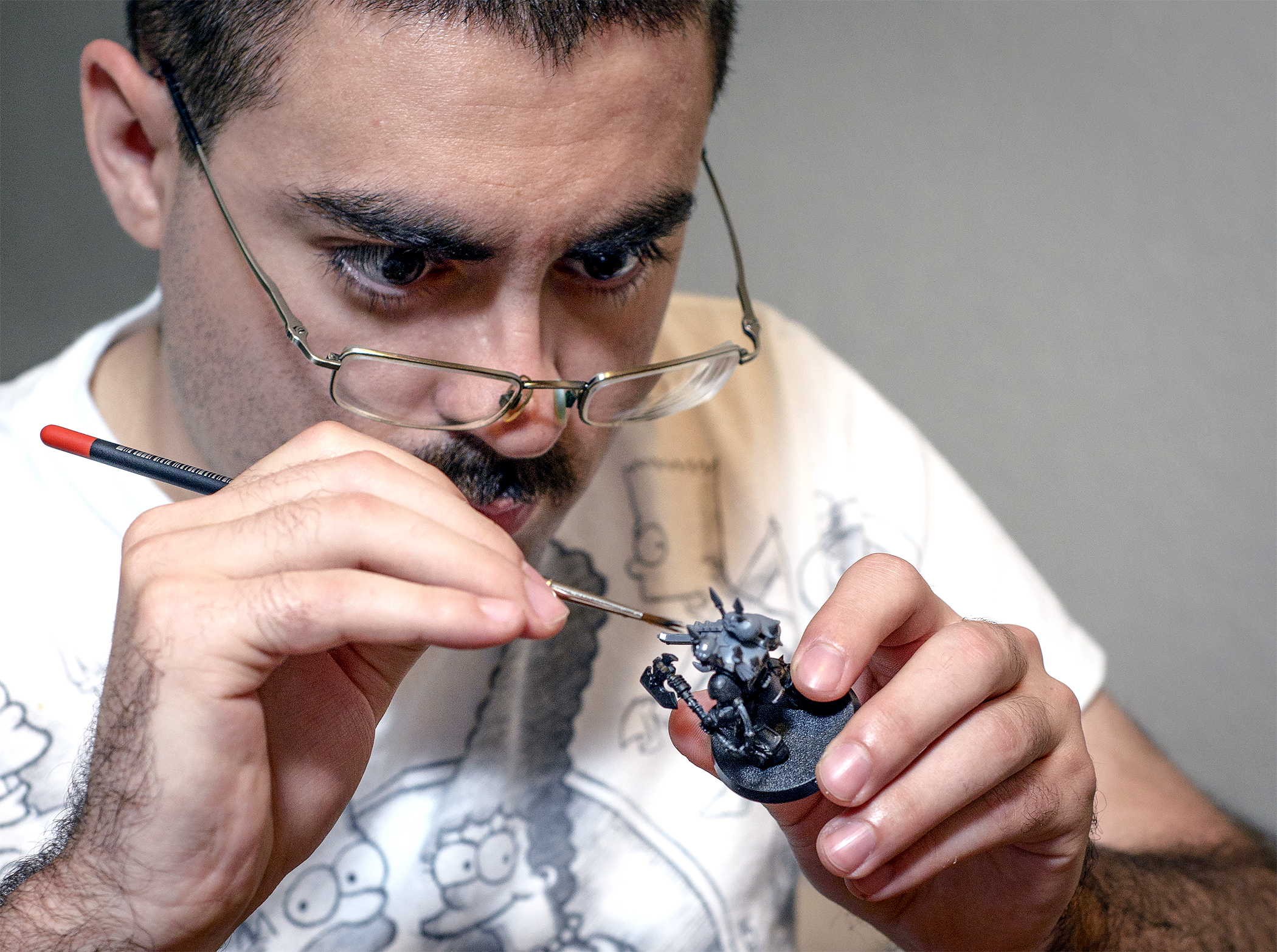
Model Figures: From Preparation to Painting with NMM and OSL Techniques
Materials, preparation, and brush painting of figures: base coat, shadows, highlights, and blending, up to advanced NMM and OSL techniques. Brands, prices, and reference communities.
Figures are perhaps the most artistic and demanding discipline in static modeling. Here, it's not about precisely assembling a kit, but about transforming a piece of raw resin or metal into a small pictorial masterpiece, where every passage of light and shadow is hand-painted with a brush. A well-painted figure can tell a story of an era, a character, an emotion in just a few centimeters of height.
This guide takes you from material selection to the two techniques that separate expert painters from beginners: Non-Metallic Metal (NMM) and Object Source Lighting (OSL).

Materials: plastic, resin, metal
Figures are produced in three main materials, each with its own characteristics.
Plastic (polystyrene / multipart)
Typical of assembly kits and wargames (Games Workshop, Warlord Games). Lightweight, easy to cut and glue with plastic cement. Good but sometimes soft detail. Ideal for beginners due to its low cost.
Resin
The material of high-end collector figures. Polyurethane resin captures very fine details and holds paint well. Requires cyanoacrylate glue and care (resin dust should be vacuumed, never inhaled). This is the material used by Pegaso Models and Andrea Miniatures.
Metal (white metal)
A tin and lead alloy, traditional for historical figures. Heavy, robust, excellent for dynamic poses thanks to the weight that stabilizes the base. It is worked with a file and saw, glued with cyanoacrylate, or soldered.
Reference brands
For figures (the subjects):
- Pegaso Models (Italian): world excellence in historical resin and metal figures, scales 54mm, 75mm, and 90mm. High-level sculptures, prices 30-90€ per figure.
- Andrea Miniatures (Spanish): another top name, wide historical and fantasy range, dedicated kits and paint sets.
- Romeo Models (Italian): refined historical figures, particularly appreciated in the 54mm segment.
For paints:
- Vallejo: the most popular acrylics in the world. The Model Color (in pots, opaque) and Game Color ranges cover every need. 17ml bottles around 3€.
- Scale75: highly pigmented resin-based acrylics, much loved for skin tones and metallic effects. The Scalecolor range is a benchmark for figure painters.
Preparation: the phase no one should skip
A figure painted on a rough preparation will always look poor. The mandatory steps:
- Removal of flash and mold lines: use a hobby knife and files to remove resin/metal burrs and lines left by the mold. This is the most important and most neglected phase.
- Washing: resin parts should be washed with lukewarm water and neutral soap to remove mold release agent, otherwise the paint will not adhere.
- Dry assembly: test fit before gluing, fill gaps with putty (Tamiya Putty, green stuff for joints).
- Primer: a thin coat of primer (Vallejo Surface Primer in bottle or Citadel/Tamiya spray) unifies the surface and provides grip for the paint. White for light and bright colors, neutral gray for general use, black for starting from a shaded base.
Tip: never underestimate mold lines. A visible line on a face's cheek, once painted, will look like a scar. Pass the hobby knife "scraping" perpendicular to the line, then smooth with a fine abrasive sponge.
Anatomy and proportions in scale
Painting well requires understanding what you are looking at. A 75mm figure represents a real person reduced in size: the volumes of the face, the folds of fabrics, the musculature are guides for placing lights and shadows. Studying anatomy and natural lighting (light comes from above, so forehead, nose, and cheekbones are illuminated; eye sockets, under the chin, and folds are in shadow) is the basis of every color choice.
Brush painting: the four pillars
Classic figure painting is built in overlapping phases.
1. Base coat application
Apply the base color in multiple thinned coats (never opaque in one go). Acrylic thinned with water or medium to a "milk" consistency, applied in thin passes to avoid obscuring sculpted detail.
2. Shadows
Darken recesses (folds, under volumes) with a darker version of the base color, applied only where light does not reach. The technique of recess shading or washes (very thinned dark glazes) creates depth.
3. Highlights
Lighten raised parts with the base color mixed with white or a lighter tone, applied to the points most exposed to light. Final highlights are small and targeted.
4. Blending
This is the gradual fusion between shadows and highlights, so there are no sharp transitions. It is achieved with wet blending (blending colors while still wet on the piece) or with glazes (very transparent washes that soften transitions). This technique gives the figure its "painted" and three-dimensional appearance.

Advanced technique: Non-Metallic Metal (NMM)
NMM consists of painting metallic surfaces (swords, armor, jewelry) using non-metallic colors — grays, whites, blues, ochres — to simulate metal reflections. The result, if well executed, is more expressive and photogenic than real metallic paints.
The principle: metal reflects the environment like a mirror, so it has extreme contrasts (almost black areas next to almost white areas) and sharp transitions. For an NMM steel, start with a medium gray, push shadows towards near-black in recesses, and place pure white highlights where the blade "reflects" the sky. It requires pre-visualizing where reflections fall: it is the technique that most tests one's understanding of light.
Advanced technique: Object Source Lighting (OSL)
OSL simulates a light source present in the scene: a torch, a glowing blade, a flame, an explosion. The effect consists of painting the light that source would project onto surrounding surfaces — a face illuminated from below by a candle, armor tinted green by a magic orb.
The golden rule: light is more intense near the source and diminishes with distance, maintaining the same hue (a flame projects orange, a magic light blue/green). OSL is spectacular in competitions but should be used sparingly: overdoing it makes it artificial. It is worked with progressive glazes of the light color, starting from the areas closest to the source.
The details that make the difference
Eyes in scale
The nightmare of beginners. In 54-75mm scale, first paint the white (actually a dirty beige, never pure white), then the iris as a small dot or arc, finally "close" the corners with a dark flesh tone to reduce the eye to the correct size. In smaller scales, only the shadow of the eye is suggested without painting the iris.
Hair and fabrics
Hair is painted following the sculpted strands, with highlights pulled along the direction of the hair. Fabrics live by folds: deep shadows in the valleys, highlights on the crests, and attention to the material (velvet absorbs light and is opaque, silk creates sharp, shiny contrasts).
Thematic bases
The base completes the narrative: a rocky terrain, a palace floor, a battlefield. A well-crafted base doubles the impact of the figure. Typical materials: textured putty, sand, gravel, pigments for earth and mud, static vegetation. The base must be consistent with the subject and never more eye-catching than the figure itself.
How to practice NMM and OSL
These two techniques are not learned by reading: they are mastered through targeted practice. For NMM, it is advisable to first practice on a simple subject with large surfaces — a smooth shield, a large sword — where it is easy to plan where lights and shadows fall. Studying photographs of real metal (polished steel, gold, bronze) and trying to reproduce their tonal transitions is the most formative exercise. For OSL, the ideal is to start with a small, well-defined light source (a candle, a glowing crystal) on a bust, to focus on the law of attenuation: maximum intensity in contact with the source, gradual fading into darkness. Filming master tutorials and replicating them step by step drastically shortens learning time.
Historical vs. fantasy painting
The two great schools share techniques but diverge in spirit. Historical figures aim for documented realism: accurate uniform colors, credible materials, measured contrasts like photography. Historical research is an integral part of the work: understanding the exact cut of a Napoleonic uniform, the real colors of a regiment, the materials of the equipment. Fantasy figures (and wargames) allow for more theatrical contrasts, saturated colors, strong OSL effects, because they tell stories of imaginary worlds where light can do what it wants. Many figure painters practice both schools, because the skills acquired in one enrich the other.
Busts, large scales, and formats
In addition to full figures, one of the most beloved categories by expert painters is the bust: the reproduction of only the torso and face of a character, typically in 1:10 or 1:12 scale. The generous scale allows focusing on facial expression, uniform details, and material textures, making it the ideal format to push blending and skin tone techniques to the maximum. Brands like Pegaso Models, Young Miniatures, and Life Miniatures produce busts of the highest sculptural quality.
The scales of full figures range from 28-35mm for wargames to 54mm (the classic historical scale), passing through 75mm and 90mm for collectors, up to 120mm and beyond for pure display pieces. The larger the scale, the more detail it requires and tolerates, but also the more mercilessly it highlights errors in color transition. For this reason, many recommend progressing gradually: mastering 54mm before tackling a 1:10 bust, where every blending imperfection is amplified.
Figures in dioramas and vignettes
A figure can stand alone or be part of a vignette (a small scene with one or two subjects) or a larger diorama. In this case, additional skills come into play: composition (the rule of thirds, the direction of gazes), the interaction between figures and the environment, the consistency of lighting. A well-constructed vignette tells a moment, an emotion, a relationship between characters, and rewards those who can combine figure painting with scenic storytelling.
Skin tones: the figure painter's test bench
Skin is the most difficult and most judged surface of a figure. A flat skin tone immediately betrays inexperience, while a well-painted skin — with its reddish undertones in vascularized areas (cheeks, nose, ears, knuckles), lighter flesh tones on the forehead, and gray-greens in shaved beards — brings the character to life. It is built from a medium base (mix of ochre, red, and white), shadows are darkened with touches of red and brown (never with black, which "muddies" the skin), and volumes are lightened with progressively lighter flesh tones. Brands like Scale75 and Andrea Miniatures offer dedicated skin tone paint sets, with pre-balanced shades that greatly facilitate the work.

Brushes and equipment
The brush is the figure painter's main tool, and its quality greatly affects the result. Kolinsky sable hair brushes (Winsor & Newton Series 7, Raphaël 8404, Da Vinci) are the standard: they hold a lot of paint, maintain a perfect tip, and last for years if cared for properly. The most used sizes are 0, 1, and 2 for base coats, and 3/0 or 5/0 for fine details like eyes and final highlights. In addition to brushes, you need a wet palette (a moist palette that keeps acrylics fluid for a long time, essential for blending), good neutral light (5000-6000K), and a magnifying glass or head-mounted visor for the smallest details.
Tip: never wash a kolinsky brush with paint pushed up to the ferrule (the base of the bristles). Load color only on the mid-tip, and at the end of the session clean with specialized soap (The Masters Brush Cleaner) reshaping the tip. A good brush poorly treated lasts a week; well treated it lasts years.
Common beginner mistakes
Knowing typical mistakes accelerates growth:
- Paint too thick: obscures sculpted details. The golden rule is "more thin coats" instead of one opaque coat.
- Insufficient contrast: a figure all in the same tone appears "flat" from a distance. In scale, more marked contrasts are needed than in reality.
- Skipping primer: paint peels off or does not adhere evenly.
- Disproportionate eyes: painted too large give a "cartoonish" expression. Better to suggest the eye than to exaggerate it.
- Neglecting the base: a sloppy base diminishes hours of painting.
Reference communities
To grow, you need to interact and receive criticism:
- Putty & Paint: the most prestigious online gallery for collector figures and competition works. Very high standard.
- CoolMiniOrNot (CMON): historical community with a voting system, more oriented towards wargames and fantasy.
- Facebook groups and dedicated YouTube channels (blending, NMM, OSL tutorials) are an inexhaustible resource.
Indicative prices for figure kits
- Plastic/wargame figure (single): 5-15€
- Metal figure 54mm: 15-35€
- Collector resin figure 75mm (Pegaso, Andrea): 35-80€
- High-end resin busts: 50-120€
- Dedicated basic paint set (Vallejo/Scale75): 20-40€
Acrylics, oils, and enamels on figures
Although acrylics dominate the scene, many high-level figure painters integrate oils and enamels into their workflow. Oil paints (Abteilung 502, the same as artistic painting) have a very long drying time that allows for very smooth blending, ideal for skin tones and large draperies. The mixed technique — fast acrylic base, then oil finishing for softer transitions — is very common in large-scale busts. Enamels find their place mainly in metallic details and some specific effects. The key is to know compatibility: oil can be applied over well-dried acrylic without problems, never the other way around without a clear coat barrier.
Photographing the finished figure
An often overlooked but crucial aspect, especially if you want to share your work on galleries like Putty & Paint, is photography. A magnificently painted figure poorly photographed will convey much less of its real value. You need diffused, neutral light (a small softbox or shielded natural light), a neutral background that doesn't distract, a tripod for stability, and accurate focus on the face. Macro allows showing details, but it is the light that reveals the volumes and blending transitions. Many judgments in online competitions are based precisely on photos, so learning to photograph is an integral part of the modern figure painter's craft.
Storage and transport
A finished figure is fragile: weapon tips, antennas, thin details break easily. For transport to competitions, cases with shaped foam inserts are used, and for home display, the indispensable display cases protect it from dust, the enemy of matte surfaces. Securely fixing the base to the bottom of the display case prevents accidental tipping that can nullify months of work.
Conclusion
Figure painting is an endless journey: even masters continue to learn. Start with a plastic subject and Vallejo paints, master the four pillars (base, shadows, highlights, blending), and only then tackle NMM and OSL. Upload your work to Putty & Paint, accept criticism, and in a year you'll be amazed at your progress. The brush, like any art tool, rewards those who persevere.