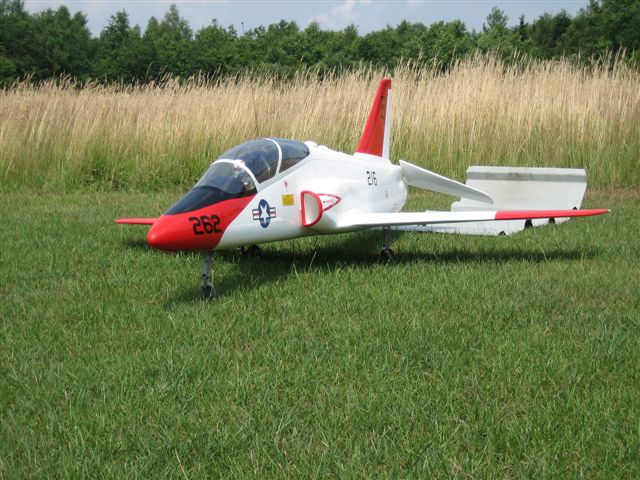
RC Electric Ducted Fan (EDF) Jet: Complete Guide to Buying and Flying
EDF guide: how an impeller works, 64-70-90-120 mm classes, brands, ESC and battery setup, EDF vs turbine, and jet flying technique.
If you love the aggressive lines of a military fighter jet but the thought of kerosene, exhaust temperatures, and four or five-figure budgets scares you, the EDF is the answer you've been looking for. An acronym for Electric Ducted Fan, the EDF is the technology that has democratized radio-controlled jet flying, bringing the aesthetics and piloting philosophy of real jets within reach of anyone with a decent flying field and a LiPo charger.
In this comprehensive guide, we will cover everything you need to know to enter the world of EDF jets: the physical operation of the impeller, the dimensional classes that structure the market, the reference brands, how to correctly size the ESC and battery, the substantial differences compared to a real turbine, a selection of models for every experience level, and – no less important – the specific flying technique that a jet requires. Because an EDF doesn't fly like a propeller trainer: it has its own logic, and learning it is half the fun.
What is an EDF and how it works
An electric impeller is, in its essence, a multi-blade fan enclosed within a cylindrical duct, driven by a high-RPM brushless motor. Air is drawn in from the front, accelerated by the rotor blades, and channeled through the stator – a ring of fixed blades that straightens the swirling outflow – before being expelled from a nozzle that increases its speed. The result is a high-velocity column of air that generates thrust, exactly like a real turbofan, but without any combustion.
The magic of the EDF lies in its ducting. A free propeller disperses energy at the blade tips and produces vortices that reduce efficiency; the duct, however, contains the flow, reduces tip losses, and allows the rotor to operate at very high RPMs – often 30,000-50,000 revolutions per minute – in a compact space that hides perfectly within the sleek fuselage of a fighter jet. This is precisely what allows an EDF model to have the realistic proportions of an F-16 or an Eurofighter, which would be impossible with a protruding propeller.
The complete EDF system consists of four elements that work in harmony: the impeller unit (rotor + stator + duct), the high-KV (high RPM per volt) inrunner brushless motor, the ESC (electronic speed controller) sized for high currents, and the high-discharge LiPo battery. Unbalance one of these, and the entire system suffers: an overstressed motor on an inadequate battery overheats the ESC, an unbalanced propeller – pardon, rotor – vibrates and loses efficiency.
Tip: The duct and the clearances between the blade tips and the duct wall are crucial for efficiency. Excessive tip clearance (gap between blades and duct) can lead to a 15-20% loss in thrust. When purchasing an EDF unit, the quality of the mechanics matters as much as the motor's power.

Dimensional classes: 64, 70, 90, and 120 mm
The EDF market is organized around the fan diameter, expressed in millimeters. This is the most important measurement because it determines the airflow, potential thrust, battery voltage class, and – consequently – the size and weight of the model. Let's look at the four main classes.
64 mm — the entry point
The entry-level class. Compact models (wingspan 60-80 cm), typical flying weight 400-700 g, powered by 3S-4S LiPo. Thrust in the order of 400-700 g. Perfect for learning the EDF philosophy in small fields, inexpensive, and forgiving. Moderate real speeds (80-130 km/h). This is the ideal class for your very first jet.
70 mm — the sweet spot
The most popular and versatile class, the true