RC Aircraft Internal Combustion Engines: Glow, Gasoline, and Methanol — Practical Guide
Guide to RC aircraft internal combustion engines: glow (O.S., Saito) vs gasoline (DA, DLE), 10-30% nitro mixtures, break-in, carburetion, glow plugs, maintenance, and comparison with electric.
There's a scent that every modeler of a certain school recognizes with their eyes closed: that of burnt castor oil coming from the exhaust of a freshly shut-down glow engine. Before electric power conquered the flying field, internal combustion engines were the beating heart of dynamic aeromodelling, and even today they represent a vibrant, sensible, and for many, indispensable choice: the roar, the warmth of the mechanics, the autonomy, the charm of a real miniature engine that demands to be understood and cared for.
This practical guide explores the world of internal combustion engines for RC aircraft: their history and current relevance, the two main families — glow (methanol/nitro) and gasoline — the reference brands, fuel mixtures, the mandatory break-in process, carburetion, glow plugs, cooling, maintenance, pairing with mufflers and propellers, and a comparison with electric power. If you're fascinated by the idea of flying a model with an engine that "lives," you're in the right place.

History and Current Relevance: Why Internal Combustion Persists
For decades, aeromodelling was synonymous with internal combustion engines. Small methanol glow engines flew generations of trainers, aerobatic, and scale models, while large displacement gasoline engines powered large-scale models. Then electric power arrived, with its cleanliness, quietness, and immediacy, conquering a large part of the market, especially among beginners and in urban parks.
Yet, internal combustion is not dead; on the contrary, it persists and thrives for specific reasons:
- Autonomy: A full tank of fuel provides flight times that electric power, for the same weight, struggles to match. For endurance flying and large-scale models, internal combustion is still king.
- Realism: The sound, the vibrations, the smell, the ritual of starting. For many, internal combustion is modeling.
- Large Scale: For large models, gasoline engines remain the most practical and economical solution compared to expensive batteries and electric motors of equivalent power.
- Mechanical Passion: Those who love to work on mechanics find a satisfaction in internal combustion that electric power does not offer.
In summary: Electric power has won on convenience, but internal combustion remains unsurpassed in autonomy, realism, and large scale. They are not enemies: they are different tools for different pleasures.
Glow vs. Gasoline: The Two Main Families
Internal combustion engines for model aircraft are divided into two distinct worlds based on fuel, ignition, and size.
Glow Engines (with incandescent plug)
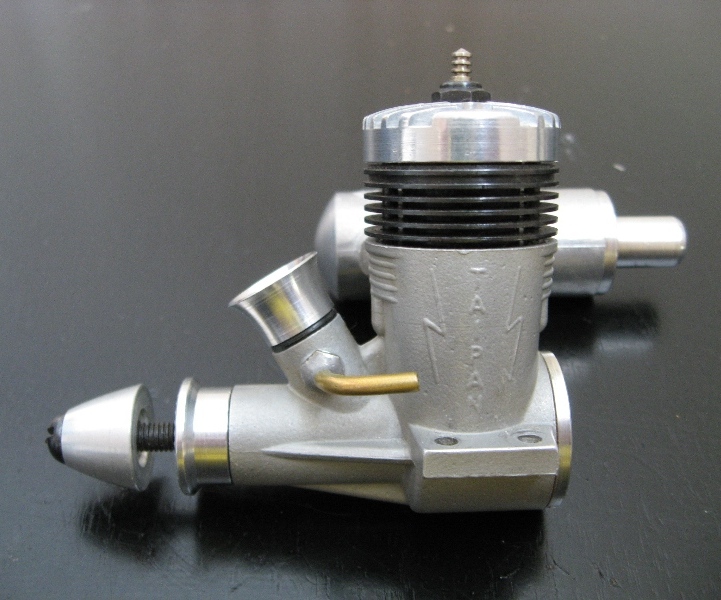
They run on methanol with added nitromethane and lubricating oil (the "glow fuel mixture"). Ignition does not occur by spark but via an incandescent glow plug with a platinum filament, kept hot by the catalytic reaction with methanol. These are the "classic" modeling engines, available from tiny displacements (.10, i.e., 0.10 cubic inches) up to robust single and twin cylinders. Typical for trainers, aerobatic, and small to medium-sized scale models.
Gasoline Engines (with spark plug and electronic ignition)
They run on unleaded gasoline mixed with oil (like a brush cutter), with spark ignition managed by an electronic unit (ignition) powered by a dedicated battery. They are generally of larger displacement (from about 20 cc upwards) and intended for large models. Advantages: gasoline costs much less than glow fuel, and hourly consumption is more economical, ideal for large-scale models that burn a lot of fuel.
The most important practical difference: glow is simple and immediate but costs more in fuel and has small/medium displacements; gasoline requires an ignition system but is economical to use and excels in large displacements.

Reference Brands
Glow Engines
- O.S. Engines (Japan): The absolute benchmark for quality, precision, and reliability. The O.S. range covers everything from small 2-strokes (e.g., .46, .55) to the splendid 4-strokes of the FS series and radial engines. Easy carburetion, legendary durability. An O.S. .55 AX typically costs around €150-220. It's the "safe bet" for anyone.
- Saito (Japan): Specialists in 4-strokes, with a deep, realistic sound, perfect for scale models. Saito single-cylinders, boxer twins, and radial engines are beloved mechanical jewels. Mid-to-high range.
- YS (Japan): Competition engines, especially for precision aerobatics (F3A), with regulated pressure fuel systems. Top-level performance and fine tuning. High-end, for specialists.
- Enya (Japan): Historic brand, robust and with a long tradition, still appreciated for reliability and "old school" character.
- ASP / SC (China): The economical option. Functional engines at very low prices (an ASP .52 around €60-90), perfect for those starting with internal combustion without a large investment or for training models.
Gasoline Engines
- DA (Desert Aircraft, USA): The premium reference for gasoline. Engines (e.g., DA-50, DA-100, DA-150) are light, powerful, extremely reliable, and with excellent support. Loved in large aerobatic and scale models. High prices (a DA-50 can exceed €600-800).
- DLE (China): The brand that democratized gasoline. Excellent engines (e.g., DLE-20, DLE-35RA, DLE-55, DLE-111 twin) at much more accessible prices than DA, with good reliability. Very widespread (a DLE-35RA around €200-300). Excellent value for money.
- Zenoah (Japan): Very robust industrial derivatives, historically popular in large scale and competition models. Solid and durable.
- GP / G-series (e.g., GP123, industrial derivative engines): Large displacements for giant models, often twin-cylinder, where abundant torque is needed for enormous propellers.
Fuel Mixtures and Nitro: From 10% to 30%
Glow fuel is composed of three ingredients: methanol (the basic fuel), lubricating oil (castor, synthetic, or a blend — because the glow engine lubricates itself with the fuel), and nitromethane, the additive that provides power and carburetion elasticity.
The nitro percentage is the key variable:
- 0-5% nitro: Used in some markets and for certain engines; "leaner" carburetion, requires precise adjustment.
- 10-15% nitro: The most common standard for trainers and general use. Good compromise between power, ease of carburetion, and cost. This is the recommended choice for beginners.
- 20-30% nitro: For aerobatic and competition engines that benefit from increased power and consistent idle. More expensive and "demanding." Always check that your engine is designed for high percentages: not all engines tolerate 30%.
The quantity and type of oil (generally 15-22% of the total) are equally important for lubrication: castor oil offers superior high-temperature protection, while synthetics keep the engine cleaner. Many commercial mixtures use a blend.
Tip: Use the fuel mixture recommended by the engine manufacturer. Starting with a good brand-name 10-15% nitro fuel, with the correct oil content, avoids most carburetion and break-in problems. For gasoline, follow the indicated oil ratio (typically 1:30 - 1:50 with quality 2-stroke synthetic oil).
Break-in: Mandatory, Not Optional
A new internal combustion engine has very tight mechanical tolerances: piston and cylinder must "mate" gradually. Break-in serves exactly this purpose, and skipping it means ruining an expensive engine from the first use. It is the most important phase of the engine's life.
Principles of glow engine break-in:
- Rich carburetion: During break-in, the mixture is deliberately kept rich (high-speed needle more open). The excess fuel and oil lubricate and cool, protecting the mating surfaces. The engine "smokes" abundantly and runs irregularly on the ground in a four-stroke manner: this is correct.
- Temperature cycles: Alternate periods at medium RPMs without ever forcing to maximum, allowing the engine to cool between sessions. Avoid prolonged full throttle.
- Gradual leaning: As tanks are consumed (often several full tanks, according to manufacturer instructions), carburetion is progressively leaned, approaching the operating setting.
- Patience: A well-done break-in takes time but results in an engine that will last for years with full performance.
Gasoline engines and 4-strokes have specific break-in procedures: 4-strokes also require particular attention to valve adjustment (see maintenance). Always follow the manufacturer's manual: each engine has its own recipe.
Carburetion: High-Speed and Low-Speed Needles
Carburetion is the art of adjusting the air/fuel mixture. On a typical glow carburetor, there are two main adjustments (plus the mechanical idle adjustment).
- High-speed needle: Adjusts the mixture at high speeds (full throttle). Turning it in leans the mixture (more air/less fuel, more power but more heat and risk); turning it out richens the mixture (more fuel, cooler and safer but less power). The correct point is slightly "rich" compared to the peak RPM, for thermal safety.
- Low-speed/idle needle: Adjusts the mixture at low RPMs, for a clean idle and good throttle response. Incorrect adjustment leads to unstable idle, flooding, or flameouts on acceleration.
- Diffuser / barrel: Determines the amount of air; rarely touched after initial setup.
The classic method for the high-speed needle: slowly open the needle until the engine "screams" at peak RPM, then slightly richen (open a bit more) until you hear a minimal drop and a constant wisp of smoke. This small "rich insurance" protects the engine from overheating. The sky test: when pulling the nose up at full throttle, the engine should not "lean out" and miss.
Tip for beginners: Always better a little rich than a little lean. A lean carburetion overheats, damages, and causes the engine to quit in flight; a slightly rich one only loses a bit of power but protects the mechanics. When in doubt, richen it.

Glow Plugs: The Heart of Ignition
The glow plug does not produce a spark: its platinum filament remains incandescent due to the catalytic reaction with methanol, initiating combustion. It is a consumable component, and its choice influences starting and regularity.
- Heat Range (cold/hot): Plugs come in different heat ranges. A "hotter" plug facilitates starting and low RPMs; a "colder" one is suitable for high nitro percentages and high RPMs. Use the heat range recommended by the engine manufacturer.
- Starting: For ignition, a 1.5 V glow plug igniter battery is used to heat the filament. Once the engine is started and warmed up, it is disconnected: the heat of combustion keeps the plug incandescent on its own.
- Wear: The plug wears out. An old plug leads to difficult starts and unstable idle. Always keep spares and replace it when the engine struggles to start or maintain idle.
- Brands: O.S. (A3, A5, F series for 4-strokes), Enya, McCoy, and others. The right plug for your engine makes a huge difference in ease of use.
Cooling
Internal combustion engines for model aircraft are almost all air-cooled: the finned cylinder dissipates heat into the airflow during flight. Proper cooling management is vital, especially on scale models with enclosed cowlings.
- Airflow over the cylinder: Air must flow over the cylinder fins, especially the head. On enclosed cowlings, intake air vents are needed and, crucially, an adequate exit section (generally larger than the intake) to allow hot air to escape. A "blocked" engine will overheat even if carbureted correctly.
- Baffles and deflectors: On cowlings, deflectors are used to force air around the fins instead of letting it pass freely around the engine.
- Carburetion and heat: Remember that lean carburetion is the primary cause of overheating. Heat and adjustment should always be considered together.
- Heat-related flameouts: An engine that quits in flight after a few minutes often suffers from overheating due to lean carburetion or insufficient cooling.
Maintenance: Break-in, Bearings, Valves, Sealing
Internal combustion engines thrive on maintenance: it's the price (and for many, the pleasure) of owning a real engine. The main points:
After Each Flight
- Cleaning oil residue: Glow fuel leaves oily residue everywhere. Clean the engine, exhaust, and fuselage to prevent buildup and to inspect the mechanics.
- "After-run oil": At the end of the day, it's good practice to put a few drops of specific oil (after-run oil) into the engine and turn it over by hand, to protect bearings and cylinder from methanol moisture (methanol is hygroscopic and promotes internal corrosion during storage).
Periodic Maintenance
- Bearings: Crankshaft bearings are subject to wear, especially if attacked by methanol corrosion. A shaft with play or that turns roughly indicates bearings needing replacement. Care with after-run oil greatly extends their life.
- Valves (4-strokes only): 4-stroke engines have valves with a clearance that needs to be checked and adjusted periodically according to specifications (usually cold, with a feeler gauge). Correct adjustment is essential for starting and performance; valves that are too tight or too loose cause serious problems.
- Sealing and compression: Periodically check compression (the "snap" when turning by hand): an engine that has lost compression has worn piston/cylinder or valves. In ABC (aluminum-brass-chrome) setups, compression is maximum when hot.
- Filters and tubes: Check and replace the fuel filter and silicone tubes that harden and crack over time.
Tip: Keep a small engine logbook: hours of operation, maintenance performed, spark plugs and bearings replaced. A well-maintained internal combustion engine can last many years and many liters of fuel.
Muffler and Propeller Pairing: Thrust and Noise
Three components work together to convert displacement into useful thrust (and acceptable noise).
Muffler
In addition to reducing noise — increasingly important for coexistence with neighbors and field regulations — the muffler contributes to fuel tank pressurization: the pressure tap on the muffler sends pressurized air to the tank, ensuring constant fuel delivery in all flight attitudes. There are standard mufflers, tuned pipes (to maximize power at certain RPMs), and quieter scale mufflers. The choice balances power, noise, and fidelity.
Propeller
As with electric, the propeller is indicated by diameter × pitch. For internal combustion, the propeller must correctly load the engine: neither too much (the engine doesn't reach RPMs and overheats) nor too little (the engine "over-revs" and stresses itself). Manufacturers indicate the recommended propeller range for each engine (e.g., a .55 glow might run well with an 11x6 / 11x7 / 12x6 depending on use). For scale flying, larger diameter and moderate pitch propellers are chosen; for aerobatics, more "aggressive" combinations.
Tip: Use an optical tachometer to verify that the engine reaches the expected RPM at full throttle with the chosen propeller. This is the tool that removes all doubt about the correct pairing and tells you if you are loading the engine well.
Internal Combustion vs. Electric: Autonomy, Weight, and Centralization
The comparison with electric helps understand when internal combustion is the right choice.
- Autonomy: Clear internal combustion advantage. A full tank offers long flight times, and "refueling" is quick — just fill the tank. Electric requires multiple battery packs and recharging times.
- Weight and energy: Fuel is energy-dense. For long autonomies, internal combustion remains lighter, and this is one reason for its survival in endurance flying and large scale.
- Weight centralization: Pay attention here. The internal combustion engine is a concentrated weight on the nose; the fuel tank is typically right behind it, near the center of gravity, so that fuel consumption does not significantly shift the CG during flight. This is a balance advantage: the model remains balanced from full to empty. In electric, batteries are positioned for balance, but their weight remains constant.
- Convenience and cleanliness: Electric wins here — no fuel, no oily residue, instant start, quietness.
- Maintenance: Internal combustion requires constant care (carburetion, plugs, bearings, valves); electric is almost "plug and play."
In summary: Choose internal combustion for autonomy, realism, large scale, and the pleasure of mechanics. Choose electric for convenience, cleanliness, and immediacy. Many modelers, in the end, keep both in their hangar.
Conclusion
Internal combustion engines represent the historical and still vital soul of dynamic aeromodelling. Methanol glow for simplicity and small-to-medium sizes, gasoline for economy of use and large scale: in both cases, we are talking about real engines that demand to be understood, carbureted with sensitivity, broken in with patience, and maintained with consistency.
Start with a good brand-name engine (an O.S. or a Saito for glow, a DLE for gasoline), use the recommended mixture, dedicate due time to break-in, learn to listen to the engine during carburetion, ensure proper cooling, and keep a maintenance log. In return, you will have a reliable flying companion with an unmistakable character, capable of providing autonomy, realism, and that purely mechanical satisfaction that only a real engine can give. Happy flying and engines always running strong.